Case study Michael Green Realty and Investment
Thirty-five years in, and a website that finally said so
Michael Green has been a broker in the San Fernando Valley for thirty-five years, and holds both a real estate license and a mortgage license. Roughly 85% of his clients work in education: teachers, principals, and district staff, many of them referred by one another, some of them on their third transaction with him. His old website said almost none of that.
Download this case study as a PDF
Before-and-after measurements were taken on September 14, 2026, on the old site and the finished rebuild, before launch. The new site went live at michaelgreenrealty.com on September 21, 2026.
How clients actually reach a broker's website
Start with how people choose an agent. In the National Association of REALTORS® 2025 Profile of Home Buyers and Sellers, 43% of buyers found their agent through a referral from a friend, neighbor, or relative, and another 15% used an agent they had worked with before. Only 6% found their agent through a website. Among sellers, 37% came by referral, 29% used an agent they had used before, and 4% came from a website.
For a referral business like Michael's, that changes the website's job. It rarely creates the lead. It confirms or loses a lead someone else already created. A former principal gives his name to a colleague, the colleague looks him up on a phone, and whatever loads decides whether the call happens.
What the old site was doing
The old site ran on a hosted brokerage platform: a template shared with many other agent sites, with a listing search integration (IDX) built into the homepage. It was designed for someone shopping for a house, not for someone checking out a broker.

- The broker was buried. On a phone, Michael's own profile card started 9.8 full screens down the homepage. The first mention of his thirty-five years came at 10.8 screens.
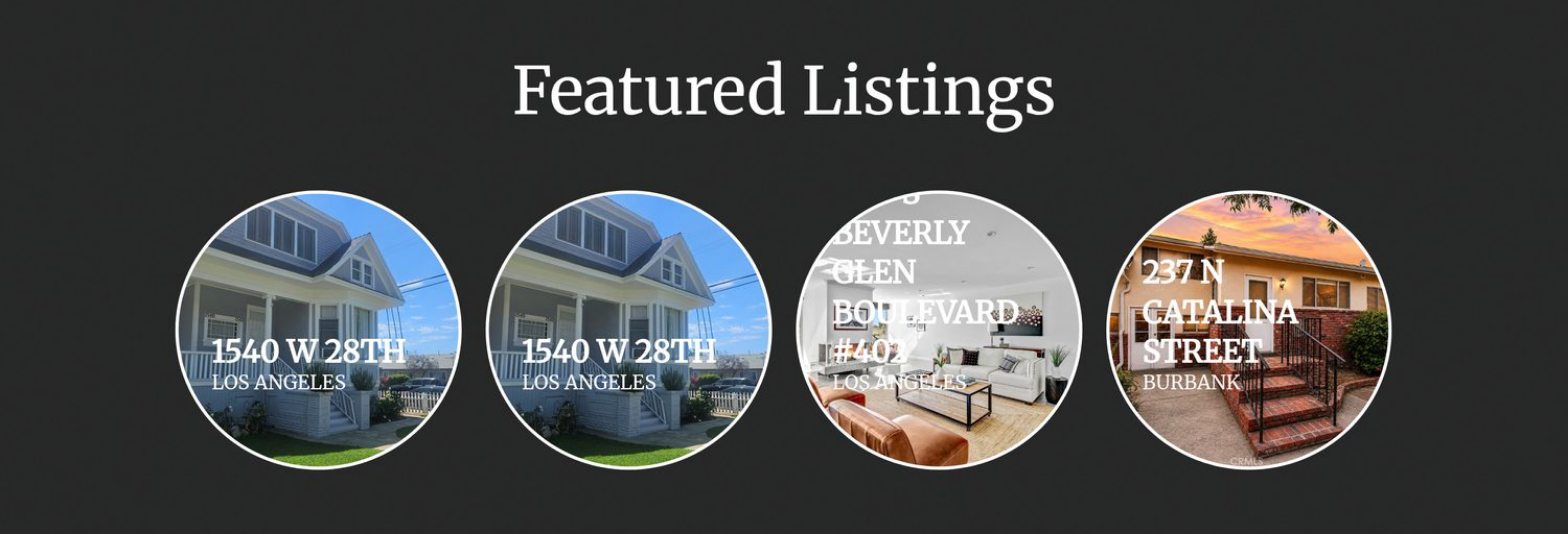
- The template misreported his own listings. The featured listings block, the most prominent section after the hero, showed the same building twice, one card with a blank bedroom count and 0 baths. Part of that was a duplicate MLS entry, but the empty fields and the address running off its circle were the template's card design, which could not be fixed by editing a page.
- Twelve stock photos filled a third of the phone page. The "featured communities" tiles used generic interiors that had nothing to do with the neighborhoods named on them.
- It was invisible to AI search. The site's robots file blocked eleven AI crawlers, including the ones behind ChatGPT, Claude, and Google's AI features, so assistants asked about brokers in Granada Hills had nothing of his to read.
- Its search settings contradicted themselves. The sitemap asked Google to index 132 listing pages that the same robots file told Google not to crawl. The homepage had no meta description and five top-level headings.
- Nothing written by a person had changed since 2023. The last blog post was dated October 2023. The only section that changed was machine-generated listing inventory.
- It was heavy. 825 KB across 55 requests before any photograph loaded, including 40 separate JavaScript files, with a median server response of just over a second.
The IDX question
The listing search was the centerpiece of the old homepage, and a recurring line on the bill. The IDX provider behind the old site publishes entry pricing of $169 a month, plus $50 a month to add a hosted website and a $500 setup fee, according to published 2026 pricing. At those list prices, that is $219 a month, or more than $13,000 over five years before anyone improves anything. We are quoting list prices, not Michael's invoice.
The question was what that search box was doing for his clients. A referred teacher looking up a broker is not trying to browse inventory on the broker's site; the big portals already do that better, from the same feed. What that visitor needs is proof that this is the right person. A search box in the most valuable position on the page competes with that, and it was being paid for every month.
The new site does not carry an IDX search at all. That was a deliberate call for this business. An agent whose clients do search on the agent's own site may reasonably keep one, ideally on its own page rather than in place of the introduction.
What we built

- The broker comes first. His portrait, his thirty-five years, and a call button are on the first screen of a phone, at 0.3 screens instead of 9.8.
- The niche leads. The 85% of clients in education, which appeared nowhere on the old site, is now the section directly after the introduction, with a photo of Michael presenting at a Los Angeles school.
- Credentials are checkable. His DRE and NMLS numbers sit under the hero and link to the public license lookups, so a visitor can verify them in one tap.
- Experience became specifics. Six concrete points replace the generic claim, starting with the one that sets him apart: the house and the financing from one licensed person.
- No form gate. The old "Your Dream Home Awaits" capture form came out. Referred callers want the number, so the cell is tappable at the top of every page, and a short contact form sits at the bottom for anyone who prefers it.
- Open to AI search. No crawler is blocked, every page has a written description, and each page has one clear top-level heading.
- Video that stays current. A videos page pulls in new clips from his YouTube channel automatically every day, so the site shows new work without anyone logging in.
Old site, phone

New site, phone

| Measurement | Old site | New site |
|---|---|---|
| Scrolling before the broker appears, phone | 9.8 screens | 0.3 screens |
| Scrolling before "thirty-five years" appears | 10.8 screens | 0.8 screens |
| Homepage height on a phone | 11,137 px | 8,694 px |
| Server response, median | 1.04 s | 0.18 s |
| Requests before any photograph | 55 | 1 |
| JavaScript files | 40 | none |
| Page weight before photography | 825 KB | 177 KB |
| AI crawlers blocked | 11 | none |
What it costs
On the open market, a fully custom real estate website runs from about $5,000 to more than $25,000 to build, according to one website vendor's published 2026 breakdown, which puts template sites at $200 to $1,000 and semi-custom builds at $1,000 to $5,000. Most hosted agent platforms then charge every month for as long as the site exists.
The new site is a small set of files Michael owns, in a repository that can be hosted anywhere. There is no platform subscription, no database, no plugins to license or patch, and no admin login to attack. It is hosted on a free tier at its size. The recurring cost of the website itself is the annual domain renewal.
The honest trade-off: there is no editor behind the site, so Michael cannot log in and change a paragraph himself. Changes go through us, under his service plan. For a small site that changes a few times a year, that trade means his monthly spend pays for work rather than rent.
What other agents can take from this
- Know which job your site does. If most of your business comes by referral, the site's job is to confirm you, fast, on a phone.
- Audit what you pay for every month. Check whether visitors actually use your listing search before you keep paying for it.
- Look at your robots file. Visit yourdomain.com/robots.txt. If it blocks AI crawlers, you are invisible to a growing share of search.
- Check the date on your words. If nothing a person wrote has changed in years, visitors and search engines can tell.
Sources and method
- Site measurements: both sites measured September 14, 2026 in a headless Chromium browser at 390 by 844 (phone) and 1440 by 900 (desktop) after a full scroll pass. Server response is the median of eight warm requests over the same connection. Sitemap, robots, heading, and meta tag findings were read from the published files.
- National Association of REALTORS®, 2025 Profile of Home Buyers and Sellers.
- Luxury Presence, IDX package pricing, 2026, and "How Much Does a Real Estate Website Cost in 2026?" Both are published list prices from a company that sells websites.
- Client figures, including the 85% of clients in education, come from Michael Green and appear on his own site.